






Die Leistung über Ihren gesamten Mietzyklus hinweg steigern
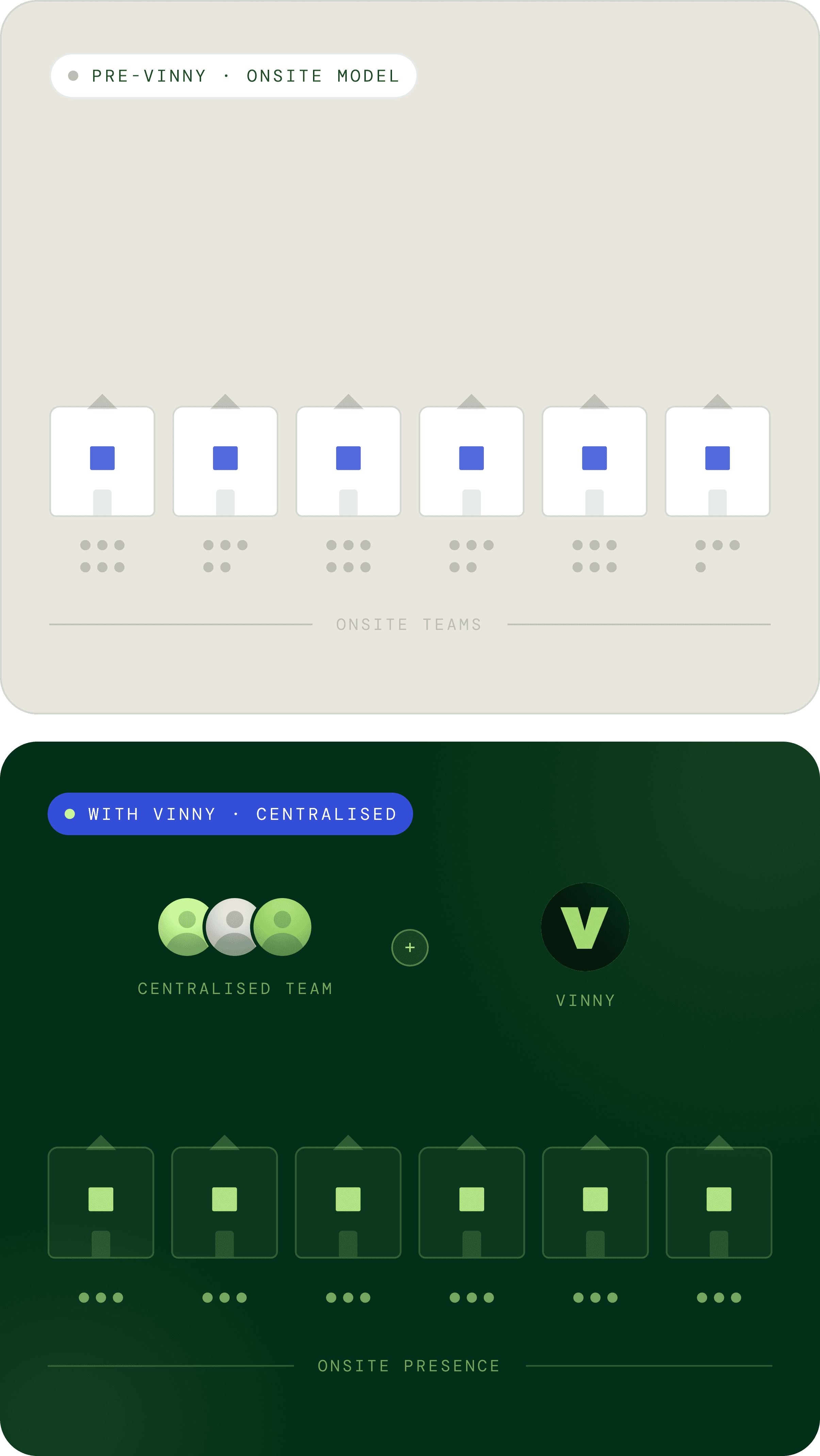
Centralising operations solves this by separating the work that needs to happen in a building from the work that doesn't. The on-site work stays local and gets done better, because the team has the time to do it. The portfolio-wide work moves into a shared model run with Vinny, and gets done faster, more consistently, at a fraction of the cost.
For UK and European operators, the case is sharper than it is in the US. Your buildings are smaller. Your brand promise is higher-touch. Your residents pay a premium for an experience, not a unit. Centralising isn't about stripping out the things that make your buildings worth living in. It's the opposite. It's about giving your on-site teams back the time and focus to deliver them.
WHAT CENTRALISATION ACTUALLY MEANS
Centralised leasing is an operating model where a single shared capability handles leasing and operations activity across multiple buildings, rather than each building running its own siloed process. One shared operation answers every enquiry, books every viewing, qualifies every applicant, processes every application, sends every renewal offer, and chases every overdue payment — across your entire portfolio.
Before any technology decision, centralisation is an operating choice: which work belongs to a single, portfolio-wide team, and which work has to stay with the people who are physically in the building.
The high volume, repetitive, always-on work.
The work that needs a person in the room.
The test we use. If the work happens identically in every building, doesn't need eyes on the property, and produces a measurable outcome. It can be centralised. If the work needs the person doing it to be in the room, you keep it in the room.
The shape you end up with isn't a headcount exercise. It's an operating model where the always-on work happens automatically, the portfolio work happens once, and the building work stays where it belongs: in the building.
why centralise now
Five reasons operators are moving on this now.
sector reality
Most of the centralisation playbooks you've read were written for US multifamily. The thinking is sound. The operating context isn't yours.
US multifamily buildings are typically larger, more standardised, and run by teams of six to ten. The economics are driven by occupancy and renewals at scale. UK Build-to-Rent, Co-Living and PBSA look different in ways that matter for how you centralise:
Smaller schemes, branded buildings.
A 250-unit BTR scheme in Manchester is run by a small team that knows the building inside out. The brand promise is higher-touch, the design language matters, and the on-site role is closer to hospitality than to property management. The centralisation question isn't how do we strip cost out of the building. It's how do we give the on-site team back the hours they're losing to admin.
Less admin per team member
how centralised leasing works
Centralisation starts with a deliberate decision about how your organisation works. A small central team takes ownership of the work that can be done from anywhere — leasing, resident communication, maintenance triage, renewals. Your on-site teams stay in the buildings, focused on the work that needs a person in the room.
Vinny is the AI teammate inside that central team. Not a tool the team uses — a working member of it. Vinny handles the high-volume, always-on work consistently across every building, without the headcount a purely human operation would require. The central team oversees the operation, manages the exceptions, the optimisation, and the relationships that need a human voice. Both groups end up doing more of what they were hired for.
Every conversation, ticket, application and renewal flows through Vinny before it reaches your central team. Together they handle the work that doesn't need to happen in the building.















what changes for your team
One of the most common mistakes operators make is trying to centralise everything at once. The better starting point is a clear-eyed split.
What Vinny handles, portfolio-wide.
High-volume, repetitive, always-on. The cost of doing this once per building is the cost of running an old operating model.
Enquiry response & lead qualification
First reply in under 10 seconds, 24/7, in the resident's language. Every lead scored and followed up automatically.
Viewing booking
Viewings scheduled from the first conversation, confirmed, and managed without anyone checking a diary.
Application processing
Reference checks, affordability, and document collection run to a single SLA, across every building.
Resident communication & triage
Every channel — WhatsApp, phonecall, email, portal — sorted, replied to, or routed in seconds.
Renewals & rent reviews
Sequenced outreach 90 days out, with personalised offers and live retention reporting.
Maintenance triage & contractor dispatch
Tickets classified, prioritised, and dispatched without an on-site coordinator in the middle.
Move-outs & deposit returns
Scheduled, evidenced, and reconciled to the day — the same way, every time.
Reporting & portfolio insights
One operating picture across every building, refreshed continuously, not monthly.
HIGH-VOLUME • REPETITIVE • ALWAYS-ON
What your people do, better.
The work that needs a person in the room. The on-site team gets their hours back to do the work the building actually needs from them.
Local marketing & show rounds
the in-person selling of the scheme, the walk that no brochure replaces.
Move-in walkthrough & key handover
The first hour in the home. Done by the person who'll see the resident in the lift on Tuesday.
Building events & community
Programming, hosting, the social rhythm that turns a scheme into a place to live.
High-touch resolution & welfare
The conversations that need a face and a name — escalations, sensitive issues, retention saves.
Contractor & vendor supervision
Eyes on the work, sign-off on quality, the relationship with the people fixing your building.
Property condition & curb appeal
The state of the lobby, the lift, the bin store — the things a resident notices on day one and day 365.
Local relationships
Council, neighbours, emergency services, the cafe on the corner. The building's standing in its street.
The judgement calls
The ten per cent of the operation a human in the building will always do better than a system.
PHYSICAL · RELATIONAL · IN-PERSON
sequencing
The fastest way to fail at centralising is to try to do all of it at once. The fastest way to succeed is to sequence it.
Leasing Funnel
The highest-volume, lowest-risk place to start. Response times drop to under 10 seconds, dropped enquiries disappear, and viewings get booked from first conversation. Vinny sends application links, chases referencing, and hands fully-qualified applicants to your team ready to close.
Maintenance
Vinny intakes every request, triages consistently, and prioritises by urgency. Residents get updates automatically. Jobs route to the right person or contractor without anyone coordinating in the middle.
Marketing
Vinny runs availability campaigns, seasonal promotions, and re-engagement sequences across every building. The right message, to the right prospect, at the right point in the cycle — without your team building it from scratch each time.
Finance
Vinny handles renewal outreach at scale, surfaces residents who need a human conversation, and runs the arrears chase that nobody on-site enjoys.
Data Led Insight
With the first four phases in place, you have something most operators don't: real data, across the whole portfolio, on what's working and where the next gain is. This is where the data starts working for you.
failure points
Most centralisation programmes don't fail at the technology layer. They fail at the people and process layer. The ones we've seen go wrong share a few patterns.
Moving on too many fronts at once.
Centralising leasing, admin, maintenance and resident services in parallel sounds efficient. In practice it overwhelms the team and dilutes the gains. Sequence it.
Centralising without baseline metrics.
If you don't know your enquiry-to-viewing rate, your viewing-to-let rate, or your average response time today, you can't prove the model worked tomorrow. Baseline first.
Underinvesting in the people side.
Most of the resistance to centralisation comes from on-site teams worried about their jobs. The operators who do this well bring the team along early, redesign the role rather than removing it, and make the career path visible.
Putting AI on top of a broken process.
Vinny doesn't fix a bad workflow. If your enquiry handling is broken today, automating the broken version just runs the broken version faster. Fix the process, then layer Vinny on.
Treating the portfolio team as a cost centre.
Portfolio teams that get treated as back-office support turn over fast. The ones that stay are the ones who own something, and can see where they're going.
what success looks like
The operators we work with don't talk about centralisation in abstract terms. They talk about specific things that change.
what centralisation delivers
Market Data - Industry benchmarks compiled from publicly available sources (2026)
Vinny Data - Aggregated across portfolios using Vinny (2026)
why vinny
There are other AI products in this market. There are other ways to centralise. Here's what makes Vinny the right partner.
Built for the Living Sectors.
Vinny understands branded buildings, higher-touch resident experiences, longer prospect journeys, multi-language portfolios, and the operating realities of smaller schemes. The product was designed for your market, not adapted to it.
Vinny is a teammate, not a tool.
Most AI products in property are a chatbot bolted onto an inbox. Vinny is built to work the way your team works, across channels, across buildings, across the whole resident lifecycle. Vinny handles the work, not just the conversations.
Live in days.
Vinny connects to your existing PMS, CRM and comms stack. No replatforming. No two-year transformation programme. Every customer sees meaningful results inside the first reporting cycle.
Better business outcomes.
That's the brief. Not a platform promise — a set of specific outcomes your team will feel in the first reporting cycle.
A partner, not a vendor.
Centralisation is an operating-model change, not a software install. We help you sequence it, design the roles, and bring the team along. We're still in the room when phase four goes live.
Vergleichen Sie Vinnys KI-Automatisierungen für den Bau von Mietwohnungen mit traditionellen Abläufen.
Does Vinny replace my PMS or CRM?
No. Vinny works with your existing systems, including Yardi, Voyager, MRI, Re-Leased and Salesforce. There's nothing to rip out.
Is centralisation only for large portfolios?
No. Operators with a few hundred units see meaningful gains from centralising enquiry handling and viewings. The bigger the portfolio, the bigger the absolute return, but the model works at smaller scale too.
How does centralisation work in Build-to-Rent specifically?
BTR centralisation typically starts with leasing and resident communications, the highest-volume activity in any scheme. On-site teams stay focused on the resident experience, events, and the things that need a person in the building. Vinny runs the enquiry-to-application journey across every scheme in the portfolio.
How does centralisation affect the resident experience?
Done well, it improves it. Faster replies, consistent communication across every channel, and maintenance requests acknowledged in minutes rather than hours. The on-site team gets their time back to focus on the interactions that actually need a person in the room.
What's the difference between centralising and outsourcing?
Centralising keeps the work in your operation, with your data, under your brand. Outsourcing moves it to a third party. Most operators prefer to centralise because they keep control of the resident experience.
Does centralising mean cutting on-site staff?
Not necessarily. Most operators reduce on-site headcount through natural attrition over time, while creating new portfolio-level roles that promote from within. The best programmes redesign the on-site role rather than remove it — and make the career path visible from day one.
What's the ROI of centralised leasing?
Lead response times drop to under 10 seconds. Enquiry-to-tour conversion runs at 2.4x the portfolio average after 12 weeks with Vinny. Beyond speed, operators see lower payroll, higher renewal rates, and cleaner data across every building. We'll model the specific numbers for your portfolio in a demo.
How long does it take to implement?
Most Vinny customers complete the leasing funnel in a month. The full operating model, including renewals, maintenance triage and marketing, lands inside half a year. The value lands earlier.
What does the sequencing look like in practice?
Most operators start with the leasing funnel — enquiry response, viewing booking, and application processing. Once that's working, renewals and maintenance follow. Marketing and campaigns come next. Each phase builds on the last, and the value is visible before the full model is in place. Vinny helps you sequence it from day one.
What is centralised leasing in residential real estate?
Centralised leasing is an operating model where a shared capability handles leasing activity across multiple buildings, rather than each building managing its own enquiries, viewings and applications in isolation. It improves response times, lifts conversion, and reduces payroll without removing the on-site experience.